Is CBD legal in Germany in 2026? The most important rules in an FAQ
Published on
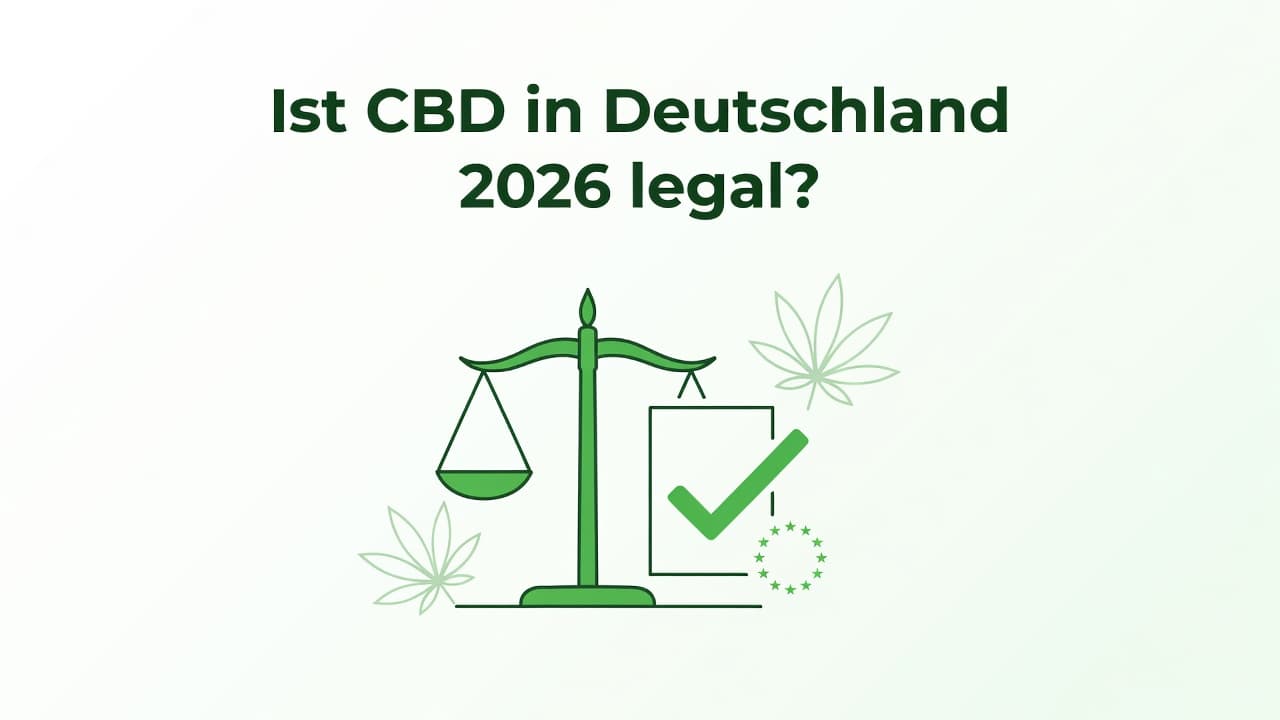
Table of contents
- Short answer
- Why there is no blanket answer
- FAQ 1 – CBD as a food and food supplement
- FAQ 2 – CBD oils and product classification
- FAQ 3 – Topical care products with CBD
- FAQ 4 – Industrial hemp and the 0.3% limit in the KCanG
- FAQ 5 – CBD flowers, extracts and isolates
- FAQ 6 – What the KCanG regulates and what it does not
- FAQ 7 – Purchasing and travel
- FAQ 8 – Documents and evidence
- Checklist for responsible purchasing
- Conclusion
- Sources
Short answer
Whether CBD is legal in Germany in 2026 cannot be answered with a simple yes or no. The legal situation depends on the product category in which the CBD article is offered, how it is presented and what THC content it has. CBD in foods and food supplements is not marketable without EU authorisation. The 0.3% THC limit in the KCanG defines industrial hemp as a raw plant, but does not automatically make any finished product tradable. Every CBD article requires its own legal assessment.
Why there is no blanket answer
The regulation of cannabidiol spans several areas of law: food law, product safety law, medicinal product law and the Consumption Cannabis Act in force since April 2024. Each body of rules assesses CBD from a different perspective and attaches to its own legal facts.
One and the same molecule – cannabidiol – can be classified differently depending on the form of presentation, appearance and composition of the finished product. In addition, the competent authorities at federal and state level interpret existing rules in partly different ways. Anyone who wants to understand the legal situation must therefore always look at the concrete product category. Labelling, composition, distribution channel and commercial communication should also always be considered together, because only the interplay of these factors determines under which legal framework a CBD-containing article is in fact to be assessed in the individual case.
FAQ 1 – CBD as a food and food supplement
May CBD be sold in Germany as a food or food supplement?
CBD is classified in the European Union as a novel food. That means: before a CBD-containing food or food supplement may be placed on the market, it must have gone through an authorisation procedure under Regulation (EU) 2015/2283. Whether a concrete article is marketable is assessed by the competent supervisory authorities in the individual case. The BVL notes that it is currently not aware of any situation in which CBD would be marketable in foods or food supplements.
The Federal Office of Consumer Protection and Food Safety (BVL) puts it as follows: “The BVL is currently not aware of any situation according to which cannabidiol (CBD) would be marketable in foods, including food supplements.“ (BVL – FAQ Cannabidiol (CBD) in foods, retrieved on 10 August 2026)
Foods and food supplements with CBD therefore require prior authorisation as a novel food under Regulation (EU) 2015/2283. Anyone offering CBD-containing capsules, gummies, drinks or drops without such authorisation is operating in an area not covered by law.
FAQ 2 – CBD oils and product classification
How are CBD oils classified in law?
CBD oils are among the most frequently requested CBD products, yet their legal classification is not uniform. Classification depends on presentation, advertising and the intended purpose of the product – that is, under which legal framework it is placed on the market.
Depending on how it is presented, a CBD oil may be assigned to food law, the law for care products or medicinal product law. A blanket classification of all CBD oils into a single category is not possible. Manufacturers and traders are responsible for determining the applicable product category and meeting all related legal requirements.
For consumers that means: pay attention to the category under which a CBD oil is offered, and check whether the manufacturer’s statements on product classification are plausible and consistent.
FAQ 3 – Topical care products with CBD
What requirements apply to topical care products with CBD?
Topical care products with CBD can be placed on the market in Germany if the general product-law requirements are met. Central prerequisites include:
- INCI declaration: All ingredients must be fully labelled on the product according to the international nomenclature (INCI).
- Responsible person in the EU: Every product needs a named responsible person established in the European Union who is liable for compliance with the applicable rules.
- Safety assessment: Before placing on the market, a safety assessment must be carried out by a qualified person and documented.
- Ban on pharmacological claims: Topical care products may not contain promises of effect that are relevant under medicinal product law. As soon as a product carries medical claims, it can be classified under medicinal product law – with far-reaching consequences for authorisation and distribution.
Responsibility for compliance with all rules lies with the person placing the product on the market.
FAQ 4 – Industrial hemp and the 0.3% limit in the KCanG
What does the 0.3% THC limit mean – and what does it not mean?
The Consumption Cannabis Act (KCanG) defines industrial hemp in § 1 Nr. 9 among other things by a THC content of at most 0.3%. This threshold is a definitional limit: it determines from which THC content a cannabis plant is classified as industrial hemp and not as consumption cannabis.
What this limit expressly does not do: it is not a general legality threshold for arbitrary CBD products. That a raw material was obtained from industrial hemp and the THC content does not exceed 0.3% says nothing about whether the finished product made from it meets the applicable product-law requirements.
The 0.3% limit is thus a definition for the raw plant, not a blank cheque for the marketability of finished products. Every product category requires its own, separate legal review.
FAQ 5 – CBD flowers, extracts and isolates
Do different rules apply to CBD flowers, extracts and isolates?
For flowers, extracts and isolates, a case-by-case review is especially important. Form, composition, presentation and marketing context can touch different areas of law; a general statement on marketability therefore cannot be derived from the designation or a single laboratory value.
The different framework conditions for flowers, extracts and isolates reflect that legislators and authorities distinguish between raw materials, intermediate products and finished products. Harmonisation is currently not in sight at either national or European level. Each product form therefore requires an individual legal review.
FAQ 6 – What the KCanG regulates and what it does not
What regulatory scope does the Consumption Cannabis Act cover?
The KCanG entered into force on 1 April 2024. It primarily regulates private home cultivation of cannabis, possession of consumption cannabis by adults and the handling of cannabis in cultivation associations. (Legal text KCanG § 1, retrieved on 10 August 2026)
What the KCanG does not regulate: it is not a comprehensive CBD product law. The permissibility of CBD in foods, food supplements or care products continues to be determined by food law, product safety law and medicinal product law. The KCanG creates clarity in distinguishing industrial hemp from consumption cannabis, but does not replace the product-specific marketability requirements.
Anyone who assumes that the KCanG automatically legalised all CBD products is mistaken. The act addresses a specific regulatory field and leaves the remaining areas of law untouched.
FAQ 7 – Purchasing and travel
What should be borne in mind when buying and carrying CBD products?
When buying online, consumers should check whether the trader is established in the EU and whether the product information – in particular on product category, THC content and ingredients – is complete and plausible.
When travelling, note: every country – including within the EU and the Schengen area – has its own rules for CBD products. What is marketable in Germany can be assessed differently in another member state. Before every trip, the current legal situation of the destination country and the carrier’s transport conditions must be checked.
When travelling outside the EU – especially to countries with a restrictive drug policy – even possession of small amounts of CBD-containing products can have legal consequences.
FAQ 8 – Documents and evidence
What documents should consumers expect from CBD providers?
Responsible CBD providers should be able to supply the following documents and information:
- Laboratory analyses (Certificates of Analysis): Test reports from independent laboratories that document concrete measured values – for example CBD content, THC content and further analysed parameters. A COA can show the tested values, but does not replace official controls and is not proof of marketability.
- Product-category declaration: A clear statement of the category under which the product is placed on the market.
- Origin information: Information on the origin of the hemp used and the extraction method.
- Complete ingredient list: Depending on the product category, the corresponding declaration – for topical care products the INCI list, for other categories the applicable ingredients or composition statement.
If this information is missing or contradictory, that is an indication of insufficient compliance by the provider. In such cases consumers should refrain from buying.
Checklist for responsible purchasing
Before you purchase a CBD product, check the following points:
- ☐ Product category clearly declared? The product is clearly assigned to a permitted category.
- ☐ No novel-food breaches? The product is not offered as a food or food supplement without EU authorisation.
- ☐ THC content stated? The THC content is declared.
- ☐ Laboratory analyses available? Current, independent test reports can be inspected.
- ☐ No health claims? The provider refrains from unauthorised promises of effect.
- ☐ Trader identifiable? The provider has a clearly recognisable registered office and can be contacted.
- ☐ Complete ingredients? All ingredients are fully and correctly declared.
Conclusion
The question of whether CBD is legal in Germany in 2026 requires a differentiated view. CBD in foods and food supplements remains not marketable without EU authorisation as a novel food. The 0.3% THC limit in the KCanG defines industrial hemp, but is not a general blank cheque for product marketability.
Consumers are well advised not to rely on simplifying statements such as “CBD is legal“ or “CBD is illegal“, but to check the concrete product category and the manufacturer’s statements. In case of legal uncertainty, consulting a specialist lawyer or the competent state authority is recommended.
The regulatory landscape around CBD continues to develop – at both national and European level. Regular review of the current legal situation remains important for manufacturers, traders and consumers alike.
This article offers general legal orientation and does not replace individual legal advice. For binding information please contact the competent authorities or a qualified legal adviser.
Sources
- Federal Office of Consumer Protection and Food Safety (BVL) – FAQ Cannabidiol (CBD) in foods
https://www.bvl.bund.de/SharedDocs/FAQ/DE/02_Unternehmer/01_Lebensmittel/03_FAQ_Hanf_THC_CBD/00_FAQ_Cannabidiol_CBD.html
Retrieved on 10 August 2026 - Consumption Cannabis Act (KCanG) § 1 – legal text via gesetze-im-internet.de
https://www.gesetze-im-internet.de/kcang/__1.html
Retrieved on 10 August 2026 - Regulation (EU) 2015/2283 of the European Parliament and of the Council on novel foods – EUR-Lex
https://eur-lex.europa.eu/legal-content/DE/TXT/?uri=CELEX:32015R2283
Retrieved on 10 August 2026